
The TPP System (True Prosperity Path System) positions itself as a hybrid program: a money-making course plus personal-development training aimed at mindset change. Its stated goal is to help users escape financial struggle and build long-term wealth through a combination of practical strategies, income-stream frameworks, and cognitive habits. In this review I cover how it works, what’s included, pricing and support, pros and cons, who it’s best for, and whether it’s likely to be a worthwhile investment in 2026.
What is TPP System?
The TPP System (True Prosperity Path System) is a comprehensive digital training program created to help people transform how they think about money and to give them the practical skills needed to build sustainable, long-term wealth. Rather than promising quick fixes or teaching only tactical hacks, the TPP System blends behavioral change, financial education, and actionable planning so users can make steady progress toward financial independence and personal growth.
CLICK HERE TO UNLOCK YOUR TRUE PROSPERITY PATH (24HRS LIMITED OFFER)
Core approach
Mindset first: The program begins by helping participants identify and dismantle limiting beliefs and emotional barriers that commonly sabotage financial progress—beliefs such as “I’m not good with money,” “rich people are greedy,” or “I’ll never have enough.” Through guided reflections, journaling prompts, cognitive reframing exercises, and proven habit-change techniques, users learn to replace scarcity-based thinking with abundance, clarity, and long-term perspective.
Practical, step-by-step strategy: Once a healthier money mindset is in place, the TPP System moves into concrete financial skills. Lessons are organized into progressive modules that cover budgeting and cash-flow management, debt-reduction strategies, building emergency savings, fundamentals of investing (risk, diversification, tax-advantaged accounts), asset allocation basics, and scalable income-growth tactics (raises, side businesses, passive income streams).
Integration for sustainability: The program emphasizes systems and routines—automating savings, setting up recurring investments, and building decision rules—so the behaviors that create wealth become habitual. It also addresses risk management, long-term planning (retirement, estate basics), and how to evaluate opportunities without reverting to old, fear-based patterns.
Format and support
Self-paced online modules with video lessons, downloadable worksheets, checklists, and budgeting/investment templates.
Practical assignments and milestone projects (for example: complete a 90-day cash-flow overhaul, draft a 3-year wealth plan).
Community access and optional small-group coaching or live Q&A sessions to provide accountability, peer feedback, and troubleshooting.
Tools for tracking progress, including metrics to monitor savings rate, debt reduction, and net worth growth, plus guidance on setting measurable financial goals.
Who it’s for and expected outcomes
Designed for beginners and intermediate learners who want a balanced program that addresses both the psychological and tactical sides of money management.
Outcomes are realistic and measurable: clearer financial priorities, improved budgeting and emergency savings, reduced high-interest debt, a working investment plan, multiple paths to increase income, and greater confidence making money decisions. Over time, participants can expect improved financial resilience and a stronger foundation for long-term wealth-building—without gimmicks or one-size-fits-all promises.
In short, the TPP System combines mindset transformation with practical financial strategies and ongoing accountability to help users move from reactive money habits to deliberate, sustainable wealth-building.
How Does TPP System Work?
The TPP System (True Prosperity Path System) is a comprehensive program that pairs mindset work with real-world financial tools and actions. It is built as a progressive, step-by-step pathway designed to move you from limiting money beliefs to concrete wealth-building habits and measurable financial progress. Each stage includes lessons, practical exercises, and checkpoints so you can both learn and apply new skills, steadily improving your financial position over months and years.
- Foundational modules: money mindset, goal setting, and habit design.
- Tactical modules: cashflow management, debt reduction, emergency funds, basic investing principles, tax basics.
- Income-building modules: side-hustle blueprints, digital business fundamentals (affiliate, freelance, content/SaaS basics), passive-income concepts.
- Scaling & sustainability: portfolio diversification, long-term wealth preservation, estate basics.
- Implementation tools: worksheets, templates, checklists, calculators.
- Community & accountability: private forum or group, monthly Q&As or coaching calls.
- Delivery format: pre-recorded video lessons, downloadable workbooks, sometimes live workshops or group coaching. Some versions include one-on-one coaching as a paid upgrade.
Step 1 — Mindset Transformation
The program begins by helping you uncover and replace limiting beliefs about money—thoughts like “I’ll never get ahead” or “investing is only for the wealthy.” This stage uses proven psychological techniques: guided journaling prompts to surface hidden beliefs, cognitive reframing exercises to change unhelpful narratives, visualization and affirmation practices to reinforce new goals, and habit-formation strategies to make the mindset shifts stick. You’ll also learn to set values-driven financial goals so your money choices align with what matters to you. Practical outputs from this step include a written “money story” you can reframe, a daily short practice (e.g., 5–10 minutes of visualization or gratitude), and clear, values-based financial intentions.
Step 2 — Core Financial Education
With your mindset aligned, the system teaches the fundamentals of personal finance in a practical, easy-to-apply way. Topics include budgeting techniques (zero-based budgeting, the 50/30/20 rule, and expense categorization), building and maintaining an emergency fund, strategies for paying down debt (debt snowball vs. avalanche), understanding credit scores and reports, basic tax considerations, and how compound interest works. Lessons combine short, actionable modules with templates—budget spreadsheets, a net worth tracker, and a debt payoff planner—so you can immediately implement what you learn and see measurable progress (e.g., monthly savings rate, debt reduction, net worth changes).
Step 3 — Wealth-Building Strategies
After mastering the basics, the TPP System introduces practical ways to grow income and assets. This section covers diversified income approaches such as developing side hustles (freelancing, consulting, gig economy work), creating online income streams (e‑commerce, content monetization, affiliate marketing), and basic investing principles (asset allocation, index funds/ETFs, dollar-cost averaging, dividend investing, and an introduction to real estate investing). Each strategy includes entry-level steps, risk considerations, estimated time horizons, and simple examples so you can choose options that fit your skill set and schedule. You’ll receive worksheets to evaluate potential side projects and checklists to set up basic investment accounts and automated contributions.
Step 4 — Step-by-Step Action Plan
TPP turns learning into consistent action with a clear, time-bound roadmap. The program breaks long-term goals into 30-, 90-, and 12-month milestones and gives weekly and monthly tasks to keep you on track. Tools include SMART goal templates, a 90-day sprint planner, habit trackers, and a “money calendar” to schedule bill management, review sessions, and investment deposits. Emphasis is placed on small, repeated actions—automating savings, weekly expense reviews, and incremental income experiments—that compound into significant financial change. Progress metrics (savings rate, emergency fund balance, debt reduction, passive income growth, and net worth) help you measure results and adjust tactics.
Step 5 — Ongoing Support & Community
To maintain momentum, the system offers ongoing support options: access to a private community forum or social group where members share wins, templates, and lessons learned; periodic group coaching calls or live Q&As with instructors; accountability partner matching; and monthly challenges to build habits and test new income ideas. Most program versions include downloadable resources (budgets, investment checklists, negotiation scripts) and periodic curriculum updates so your learning keeps pace with changing financial tools and opportunities. The community component is designed to provide encouragement, practical feedback, and real-world examples from people at different stages of the journey.
Who benefits and what to expect
TPP is suited for people who want a structured, long-term approach to improving their finances—whether you’re rebuilding after debt, aiming to accelerate savings, or exploring ways to generate extra income. While results depend on individual effort and circumstances, participants can expect clearer financial priorities, measurable improvements in budgeting and savings habits within weeks, and steady progress toward income and investment goals over months. The system emphasizes sustainable growth: mindset first, education second, action third—so changes are more likely to last.
Practical next steps
Start by completing the mindset exercises and setting one clear 90-day financial goal (e.g., save $1,000, pay off a credit card, or launch a small side-hustle). Use the program’s budgeting template to track one month of spending, then commit to one wealth-building experiment (automate $50/month to an investment account or list three freelance services you can offer). Join the community for feedback and an accountability partner to keep momentum.
The TPP System blends psychological change, financial literacy, practical income strategies, and an action-focused plan so you can move from intention to measurable financial progress and long-term prosperity.
CLICK HERE TO UNLOCK YOUR TRUE PROSPERITY PATH (24HRS LIMITED OFFER)
Key Features of TPP System
Comprehensive Mindset Training
This program begins by addressing the most common mental and emotional barriers that block financial progress. Through a combination of evidence-based techniques and practical exercises, you will learn to identify and reframe limiting beliefs about money—such as scarcity thinking, fear of failure, and self-sabotaging narratives—and replace them with empowering, success-oriented habits. Training elements include guided visualizations, thought-reframing worksheets, confidence-building assignments, and goal-setting frameworks designed to cultivate a resilient, wealth-focused mindset over time.
Step-by-Step Training Modules
The course is organized into a clear, progressive curriculum so you always know the next step. Each module contains short, easy-to-follow video lessons, written summaries, and action tasks. The material is paced for both beginners and intermediate learners, with suggested time commitments and checkpoints:
Module examples: Foundations of Money Mindset, Income Growth Strategies, Smart Spending and Budgeting, Fundamentals of Investing, and Long-Term Wealth Habits.
Lesson length: typically 10–30 minutes per video, plus practical exercises.
Learning format: video, downloadable notes, short quizzes to check understanding, and optional assignments to practice new skills.
You can move through the modules at your own pace and follow a recommended roadmap if you prefer structured progress.
Proven Wealth-Building Strategies
Alongside mindset work, the program teaches practical, actionable financial strategies you can implement immediately. Concepts are introduced at a foundational level and then expanded with real-world examples:
Income growth: ways to diversify income, improve negotiation skills, develop side-income ideas, and increase value in your existing career.
Money management: clear guidance on budgeting systems, cash-flow planning, emergency funds, and reducing high-cost debt.
Basic investing: simple explanations of asset classes, risk vs. return, diversification, and how to start investing with limited capital.
The emphasis is on sustainable, long-term wealth creation rather than get-rich-quick schemes, with tools and templates to help you build steady momentum.
Actionable Implementation Plan
To turn learning into results, the course provides a step-by-step implementation framework that breaks complex ideas into manageable tasks:
- 30/60/90-day action plans with prioritized goals and weekly milestones.
- Daily micro-habits and checklists (for example, a 10-minute financial review, saving triggers, and spending reflections).
- Practical templates for budgeting, bill-pay automation, goal tracking, and investment checklists.
- Regular review routines to measure progress and adjust plans.
- This structure encourages consistent small actions that compound into measurable financial improvement.
Access to Course Materials
When you enroll, you receive long-term access to all course resources so you can revisit concepts whenever you need:
- Lifetime or extended access to recorded lessons and updates.
- Downloadable guides, worksheets, spreadsheets, and printable templates for budgeting, net-worth tracking, and investment planning.
- Transcripts and summary notes for each lesson, plus suggested reading lists and resource links.
Periodic content updates to reflect changes in tools, markets, and best practices (when applicable).
Private Community Support
Learning is reinforced through social accountability and peer feedback. The program includes access to a private community where you can:
- Connect with like-minded learners to share experiences, challenges, and wins.
- Participate in moderated discussions, group coaching calls, and occasional live Q&A sessions.
- Join small accountability pods or mastermind groups for support on specific goals (e.g., saving for a house, starting a side business, learning investing basics).
This community helps maintain motivation, offers practical tips from others at similar stages, and creates opportunities for encouragement and shared resources.
Beginner-Friendly Approach
No prior financial expertise is required. All concepts are explained in plain language with step-by-step instructions and plenty of examples:
- Simple, jargon-free explanations and analogies to make unfamiliar topics accessible.
- Multiple learning formats (video, text, worksheets) so you can choose what works best for you.
- Progressive difficulty: start with core fundamentals, then apply learnings to more advanced strategies as you gain confidence.
Whether you’re just starting your financial journey or want to strengthen basic skills, the course is designed to be approachable, practical, and immediately useful.
What You Get From TPP System
- Core curriculum (on-demand video lessons + transcripts).
- Downloadable workbooks and planning templates.
- Access to a private community (Slack/Discord/Facebook or built-in forum).
- Monthly group coaching or live Q&A sessions (frequency varies by plan).
- Optional add-ons: 1:1 coaching, done-for-you services, advanced masterminds.
- Tools/partnership discounts (budgeting/investing apps, business tools).
Comprehensive Wealth Mindset Training Modules
Our in-depth modules guide you through the psychological and practical work required to reshape your relationship with money. You’ll learn to identify and eliminate limiting beliefs, reframe scarcity thinking, and replace self-sabotaging patterns with confidence-building habits. Each lesson includes guided exercises—such as journaling prompts, visualization practices, and daily habit checklists—plus assessments to track your progress and a personalized action plan to embed a success-driven mindset into your everyday routines.
Proven Strategies for Financial Abundance
Practical, actionable strategies are presented step-by-step so you can increase income and build lasting wealth. Topics include optimizing your current income (salary negotiation and career growth), developing diversified income streams (side businesses and passive-income options), and scalable approaches to expand earnings over time. You’ll receive frameworks for goal-setting, cashflow mapping, and prioritizing opportunities so you can create sustainable, measurable results rather than one-off gains.
Access to All Course Materials
Receive complete access to every training resource in multiple formats for flexible learning. The course includes high-quality video lessons with transcripts, downloadable guides, printable worksheets, templates, checklists, and ready-to-use planning tools. Materials are organized by module and intended learning pace, available on desktop and mobile, with options for offline download so you can study whenever it fits your schedule.
Private Community of Like-Minded Achievers
Join a supportive, focused community where members motivate one another and share practical insights. Connect in moderated forums and small mastermind groups to exchange ideas, troubleshoot challenges, and celebrate milestones. Regular accountability structures—such as group challenges, peer check-ins, and live Q&A sessions—help you stay consistent, receive feedback, and build relationships with people pursuing similar financial and personal goals.
Advanced Investment Fundamentals
Build a solid foundation in investing so you can make informed decisions with confidence. Lessons cover core concepts including time horizon and compounding, risk versus return, different asset classes (stocks, bonds, real estate, alternatives), and how fees and taxes affect outcomes. The curriculum emphasizes practical skills—reading performance metrics, evaluating investment options, and developing a long-term mindset—so you can move from uncertainty to a clear, manageable investing approach.
Strategic Asset Allocation Mastery
Learn how to design and maintain an allocation strategy that balances growth objectives with risk tolerance. You’ll explore the principles of diversification, tactical versus strategic allocation, rebalancing techniques, and methods to reduce downside risk while pursuing higher potential returns. The training includes sample allocation models, scenario planning for different life stages and market environments, and guidance on integrating income-producing and growth assets into a cohesive, long-term financial plan.
Pros and Cons of TPP System
Pros
- Integrates mindset work with tactical financial training, which helps some people bridge the gap between knowing and doing.
- Structured curriculum and implementation materials (worksheets, checklists) that make it easier to act.
- Community accountability can increase follow-through for many learners.
- Scalable: offers both entry-level education and higher-touch coaching options for those who want more support.
- Emphasis on sustainable wealth (budgeting, investing, risk management) rather than get-rich-quick tactics (based on program claims).
Beginner-friendly training: The course is organized into clear, easy-to-follow modules that progressively build foundational skills. Lessons use simple language, practical examples, and short action steps so that people with no prior experience can understand core concepts and start implementing them quickly. Suggested pacing and recap sections help reinforce learning for absolute beginners.
Balanced focus on mindset and strategy: Rather than only teaching technical tactics, the program combines personal development (habit formation, goal-setting, confidence-building) with concrete income-generating methods. This dual approach helps learners cultivate the persistence and mindset needed to follow through, while also providing repeatable strategies they can apply to generate revenue online.
Step-by-step system and roadmap: The training offers a structured sequence of lessons and milestones designed to guide users from initial setup to execution. Checklists, templates, and suggested timelines reduce guesswork and make it easier to track progress. The roadmap clarifies what to do next at each stage so that learners can move forward with intention instead of getting stuck.
Practical online income methods: Core modules teach commonly used online business strategies such as affiliate marketing (promoting third-party products for commissions) and creating and selling digital products (ebooks, courses, templates, printables). Lessons explain how these models work, how to choose niches, and provide actionable steps for promotion and monetization.
Community support and peer accountability: Enrollment typically includes access to a community of fellow learners—forums, chat groups, or private social channels—where members can ask questions, share wins, and offer feedback. This peer network provides motivation, real-world tips, and occasional troubleshooting help from people at different stages of the same journey.
Flexible, self-paced learning: Content is available online so learners can access materials from anywhere and progress at their own speed. This flexibility suits people juggling work, family, or other commitments, allowing them to pause, revisit, or accelerate sections according to their schedule.
Cons
No guaranteed results: Many learners achieve meaningful results by consistently applying the strategies and lessons taught in the course. Success is influenced by factors such as dedication, effort, prior experience, and the ability to implement what is learned. The course is designed to provide valuable knowledge, practical tools, and actionable guidance to help participants work toward their goals. Individual outcomes will vary, and long-term success is often supported by ongoing learning, testing, and refinement of strategies.
Potential for information overload: Because the program covers both mindset work and multiple business strategies in depth, some beginners may feel overwhelmed by the volume of information and choices. New learners can mitigate this by following the recommended roadmap closely, focusing on one strategy at a time, using checklists and templates, and asking for help in the community when confused.
Time and discipline required: Implementing the tactics taught requires regular time investment and discipline—creating content, building audiences, testing offers, and optimizing funnels don’t happen overnight. Those unable to commit consistent effort may see slower or limited progress.
Variable support quality: The usefulness of community and support resources can vary based on how active and experienced other members and moderators are. Some cohorts provide frequent expert input and prompt responses, while others are more peer-driven; users should evaluate the level of support available and supplement with external resources if needed.
Who the TPP System is best for
- People serious about changing financial habits and willing to do the work over months or years.
- Beginners who want a guided framework that covers both mindset and practical money topics.
- Individuals who benefit from community support and accountability.
- Those exploring side-income ideas who need a starting framework rather than complete done-for-you solutions.
TPP System Price
The True Prosperity Path (TPP) System is a comprehensive, structured digital program designed to reshape how people think about money, success, and abundance. Built as a mindset and personal-development curriculum, TPP focuses on practical mental frameworks as well as actionable habits that help participants make more intentional financial and life choices. The program is delivered online through a dedicated learning portal and includes a combination of instructional video lessons, guided exercises, reflective worksheets, and ongoing implementation plans to translate ideas into measurable progress.
TPP SYSTEM INSTANT MEMBER AREA AND VIDEO COURSES ACCESS (24HRS LIMITED OFFER)
Cost and access
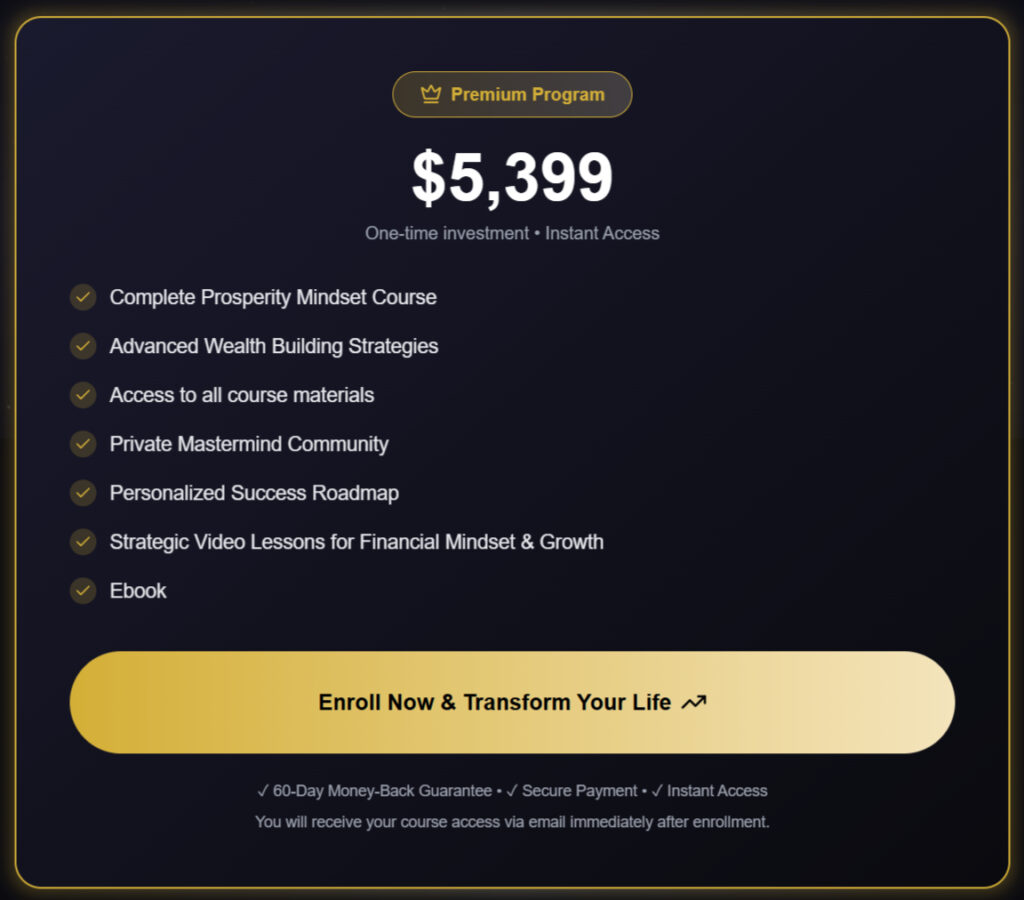
The full TPP System is offered for a one-time payment of $5,399. This single payment grants access to the core curriculum and the digital materials included at the time of purchase. (Any optional add-ons, live coaching, or future premium services may be priced separately — please check the official site for the most current offerings and any available payment options.)
What the program emphasizes
The program places primary emphasis on awareness and belief alignment: identifying limiting beliefs about money and success, understanding their origins, and replacing them with constructive, empowering beliefs.
Long-term thinking and sustainable change are central goals. TPP is intentionally not a “quick-fix” or get-rich-quick scheme; instead, it focuses on gradual, reliable shifts in decision-making, habits, and financial behavior that compound over time.
Content blends mindset work with practical tools — such as goal-setting frameworks, habit formation strategies, decision trees for financial choices, and stress-management techniques — so participants can apply what they learn in everyday life.
Results and intended outcomes
Participants can expect guided support for increasing financial confidence, clarifying priorities, creating longer-range plans, and developing consistent habits that support prosperity. The emphasis is on measurable personal growth rather than promises of specific monetary returns.
Satisfaction guarantee
The TPP System comes with a 60-day money-back guarantee. If you are not satisfied within 60 days of purchase, you may request a full refund by following the program’s refund process. For exact refund terms, timelines, and any required steps, review the guarantee details provided at enrollment or contact the support team directly.
Learn more or enroll
For a detailed syllabus, module descriptions, enrollment instructions, or questions about payment and support, please visit the official True Prosperity Path website or reach out to the program’s customer support team. They can provide the latest information about course content, any available bonuses, and assistance with registration.
TPP System Money-Back Guarantee
The TPP System includes a 60-day money-back guarantee that lets you try the entire program completely risk-free. From the date of purchase you have a full 60 days to evaluate the content—watch the training modules, work through the lessons, apply the strategies in your own context, and decide whether the program meets your needs. If at any point within those 60 days you feel the training does not live up to your expectations, you may request a full refund—no hoops to jump through and no questions asked.
This guarantee is designed to remove any pressure from your decision to join. It communicates the creators’ confidence in the value of the TPP System and their commitment to customer satisfaction: they believe the material will deliver, but if it doesn’t, you won’t be out of pocket. We recommend using the guaranteed period to follow the recommended sequence of modules, complete the exercises or implementation steps, and track your progress so you can make an informed judgment. If you decide the program isn’t right for you, simply contact our support team within the 60-day window to request your refund and it will be handled according to the policy.
Who are the TPP System Secrets for?
The phrase “TPP System Secrets” is ambiguous by itself, so the likely target audience depends on what “TPP” actually refers to in the product’s sales copy. Below are the main groups who might find value in a course, toolkit, or framework labeled this way, with concrete details on what each group would gain, what the course is likely to cover, and how to tell whether it’s aimed at them.
1) Internet marketers and affiliates
Who they are: People who promote products online to earn affiliate commissions, run digital marketing agencies, or manage direct-to-consumer funnels.
What they’d get: Step-by-step funnel blueprints, cheat sheets on ad targeting and split-testing, email sequence templates, conversion rate optimization tactics, and ways to automate lead capture and follow-up.
Likely content: Traffic acquisition strategies (paid ads, native, SEO, social), funnel architecture, landing page design, tracking and analytics setup, and monetization models.
Signals it’s for them: The copy emphasizes “plug-and-play funnels,” “high-converting templates,” “scaling ad spend,” or “automation that runs while you sleep.” Testimonials reference affiliate earnings, ROAS, or lead-cost improvements.
2) Aspiring entrepreneurs wanting a done-for-you framework
Who they are: People who want to start an online business quickly without building everything from scratch—often solopreneurs, small business owners, or novices who prefer guided systems.
What they’d get: Business model selection guidance, niche validation checklists, productized service or digital product templates, launch plans, and operational SOPs to replicate success.
Likely content: Market research methods, minimal-viable-offer creation, stepwise launch roadmaps, outsourced implementation guides, and legal/fulfillment basics for online stores or info products.
Signals it’s for them: The product promises “start-from-zero” blueprints, “done-for-you” assets, turnkey launch sequences, or mentorship/implementation support to get a business off the ground quickly.
3) Service providers, freelancers, or third-party vendors
Who they are: Companies or individuals who provide services to other businesses—this could include logistics firms, payment processors, BPOs, marketing agencies, or IT providers. (If “TPP” stands for “Third Party Providers,” this audience becomes especially relevant.)
What they’d get: Proposal templates, contract negotiation tactics, client-acquisition playbooks, operational efficiencies, and frameworks for scaling service delivery while maintaining margins.
Likely content: How to position B2B services, case-study templates, pricing strategies, onboarding flows, performance SLAs, and how to win or retain large contracts.
Signals it’s for them: The copy highlights “win more contracts,” “scale your service operations,” “reduce churn,” or includes language oriented to procurement teams, RFP responses, or enterprise sales cycles.
4) Traders or investors
Who they are: Active traders and investors focused on stocks, forex, commodities, or crypto who are seeking edge strategies, pattern systems, or automated approaches to market entry/exit.
What they’d get: Specific trading rules, charting setups, risk management parameters, backtesting processes, and possibly algorithmic/automation guidance.
Likely content: Trade setups and indicators, money management rules, position-sizing methods, historical performance examples, and instructions for using trading platforms or bots.
Signals it’s for them: The product references “trading methodology,” “signal systems,” “backtested performance,” “win-rate,” or includes screenshots of charts and trade journals.
How to decide if TPP System Secrets is right for you
Look for language that matches your goals: funnel automation and ads = marketers; turnkey business launch = aspiring entrepreneurs; contracts and service delivery = third-party providers; charts and backtests = traders.
Check included assets: templates and plug-and-play funnels suggest marketers/entrepreneurs; RFP and SLA templates point to service providers; trade indicators and historical result tables indicate traders.
Evaluate skill and commitment required: some systems assume you have ad budgets or audience lists, others include basic onboarding and done-for-you components.
Assess claims vs. evidence: seek realistic case studies, transparent methodology, and clear deliverables rather than vague “secret” promises.
In short, TPP System Secrets could be aimed at different audiences depending on how “TPP” is defined. Use the product descriptions, example assets, and testimonial types to determine whether the course is tailored to your specific needs—marketing automation, business startup, B2B service growth, or trading strategy.
TPP System Review: Real Customer Reviews & Complaints
⭐ John D. from Houston, TX ★★★★★
“Finally, a system that connects the dots.”
I’ve bought countless “business system” courses over the years, and most of them were heavy on big-picture theory but light on practical implementation. TPP System Secrets was the opposite: it gave me clear, step‑by‑step automation workflows that I could plug in right away. By using the program’s pre-built workflow templates and straightforward setup instructions, I automated lead capture, follow-up sequences, appointment scheduling, and routine onboarding tasks. That automation alone reduced my weekly workload by about 15 hours, so I could spend more time on revenue-generating work instead of repetitive admin. The materials are practical, the examples are realistic, and the overall value exceeded the price—my only regret is not finding it sooner. Date of experience: March 2026
⭐ Sarah K. from Manhattan, NY ★★★★★
“Perfect for beginners who are overwhelmed.”
I was completely lost when it came to online marketing — there were so many channels and tactics, and I didn’t know where to start. TPP System Secrets broke everything down into manageable daily tasks and a clear 60‑day action plan that felt achievable. The outreach templates (email scripts, follow-up messages, and outreach sequences) made it easy to start contacting prospects confidently, and within 60 days I landed my first three clients using those exact templates. When I ran into technical hurdles during setup, customer support was prompt and helpful — quick responses via chat and email plus step‑by‑step guidance that got me back on track. Date of experience: February 2026
Final verdict — Is the “TPP System” worth it?
Short answer: No. Based on available information, the term “TPP System” in searches overwhelmingly refers not to a consumer product or legitimate service but to the Trans‑Pacific Partnership (TPP), an international trade agreement that has been the subject of intense controversy. There is no verifiable evidence that a bona fide consumer-facing program called a “TPP System” exists that provides meaningful value. When the phrase is tied to the trade agreement, the potential costs appear to outweigh any claimed benefits.
Why this conclusion is reached
Confusion over the name: Online results for “TPP System” largely point to the Trans‑Pacific Partnership treaty and coverage of its provisions and negotiations. That means people searching for a consumer product or “system” under that name are most likely to encounter debate about the trade pact rather than a legitimate commercial offering. No reliable sources describe a separate, verifiable “TPP System” that delivers consumer value.
The TPP System can be a worthwhile investment for motivated beginners and intermediate learners who want a combined mindset + tactical approach, structured guidance, and community accountability. It is not a magic solution—real progress requires consistent execution, time, and realistic expectations. If you choose to buy, do so after confirming the curriculum fits your needs, understanding the full cost (including likely upsells), and making use of any refund window if the content doesn’t match what was promised.
Secrecy and democratic concerns: The TPP negotiations were criticized for being conducted largely behind closed doors with limited public oversight. Critics argued this secrecy reduced democratic accountability and made it difficult for citizens, consumer advocates, and independent experts to assess the treaty’s likely effects before it was finalized.
Job losses and downward pressure on wages: Independent analyses and opponents warned that trade rules in the TPP could encourage companies to move production offshore to lower‑cost countries, potentially costing domestic jobs and exerting downward pressure on wages in affected industries.
Threats to public health and consumer protection: Opponents argued certain provisions could limit governments’ ability to regulate products, food safety, and consumer protections. Some analyses claimed that weakened regulatory space or enforcement mechanisms could increase the flow of imported goods with lower safety standards.
Intellectual property and access to medicines: One of the most frequently cited concerns was the TPP’s proposed intellectual property rules. Critics said extended patent protections and data exclusivity provisions would raise the cost of prescription drugs and delay the entry of cheaper generic medicines, a policy outcome that some public health experts described as likely to contribute to preventable suffering and death by limiting affordable access to treatment.
Investor-state dispute settlement (ISDS) and legal exposure: The agreement’s investor‑state dispute mechanisms were criticized because they allow foreign corporations to sue governments in international tribunals over policy changes that affect expected profits. Opponents argued this could chill public-interest regulation (for example, environmental protection, health measures, or labor laws) and transfer regulatory authority from domestic courts and legislatures to private arbitration panels.
Widespread organized opposition: The treaty drew opposition from a broad spectrum of groups — public interest organizations, environmental and health advocates, labor unions, and multiple political leaders and presidential candidates — who raised the concerns above and mobilized against the agreement.
Putting the pieces together
Because the search term most commonly points to the controversial trade agreement and because independent analyses and a wide range of advocacy groups have documented and warned about concrete risks — to jobs, wages, public health, regulatory control, and access to medicines — the balance of evidence suggests the “TPP” in this context is not worth it. With no credible evidence of a distinct, beneficial “TPP System” for consumers, and with the documented harms associated with the trade pact itself, the potential costs and harms outweigh any potential gains.